
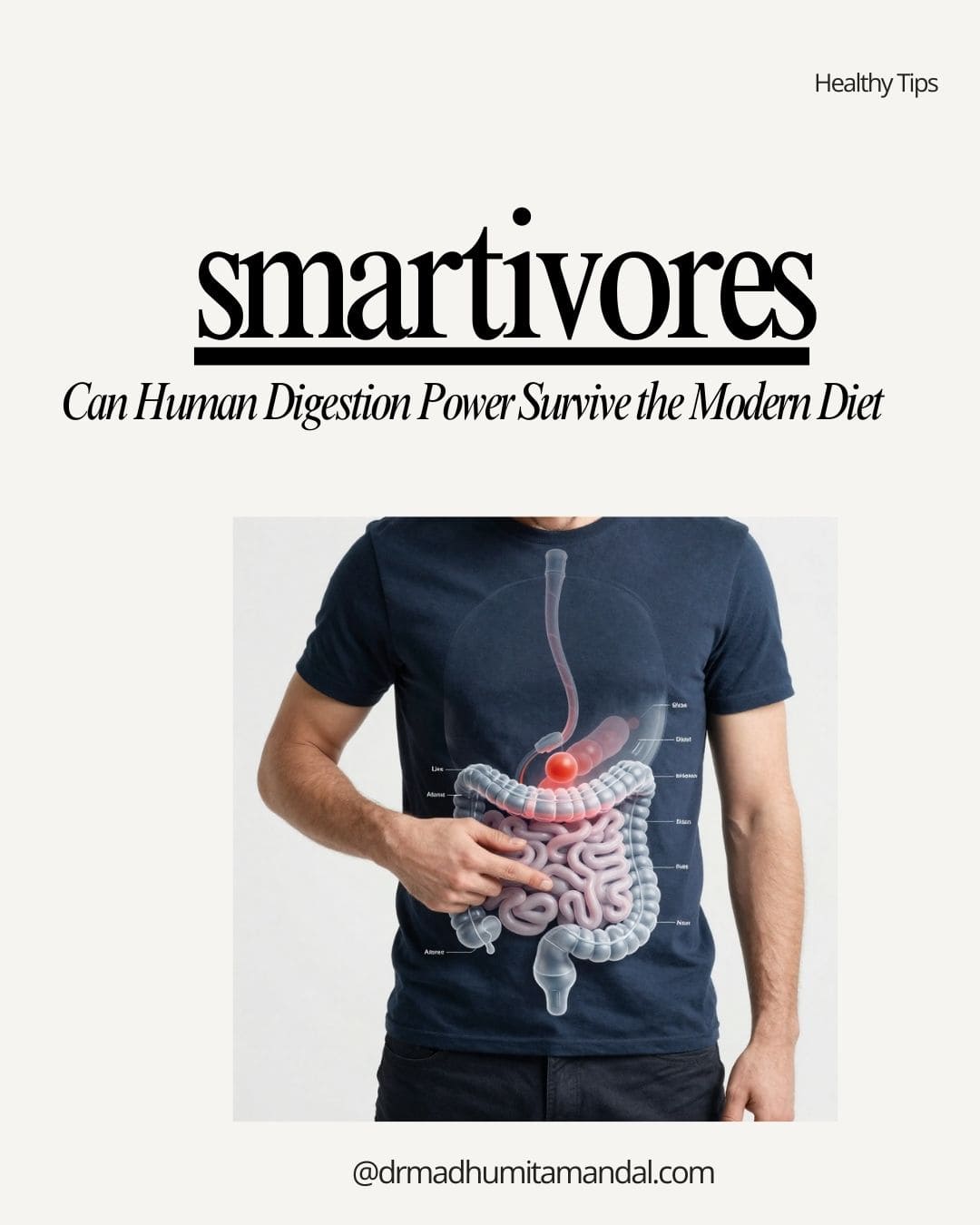
The Evolutionary Genius of Human Digestion – How humans became Smartivores. In later time, Smartivore’s Dilemma: How Modern Diet Is Testing Human Digestion Power. Stand before a mirror and consider remembering this: you are a walking, talking testament to millions of years of dietary experimentation. Unlike the lion prowling the savanna with its short, acidic gut built for quick meat digestion, or the cow contentedly chewing cud with its four-chambered stomach designed for breaking down tough plant fibers, you are something altogether more remarkable. You are a smartivore—an intelligent omnivore whose digestive system represents nature’s most versatile eating machine.
The term “Smartivores” isn’t just clever wordplay. It captures a fundamental truth about human evolution. While other species committed to dietary paths that locked them into ecological niches, early humans hedged their bets. They developed a digestive system that could extract nutrients from almost anything edible—tubers and berries, nuts and seeds, fish and fowl, insects and mammals. This dietary flexibility wasn’t just advantageous; it was revolutionary. It allowed our ancestors to survive ice ages, droughts, and migrations into unfamiliar territories where familiar foods were scarce.
But here’s the troubling paradox: the very adaptability that carried humanity through millennia of uncertainty is now being tested like never before. Not by scarcity or natural disaster, but by abundance—an overwhelming cascade of ultra-processed foods, chemical additives, and eating patterns that would be utterly unrecognizable to our hunter-gatherer ancestors.
The Goldilocks Gut: Not Too Long, Not Too Short
To understand why modern diets, pose such a challenge, we first need to understand what is human digestive tract. If you could uncoil your intestines and measure them end to end, you’d find approximately 20 to 30 feet of digestive tubing—a length that tells its own evolutionary story.
Consider a sheep, whose intestinal tract stretches an impressive 80 to 115 feet—nearly four times longer than a human’s. This extended length is necessary for herbivores to extract nutrients from cellulose-rich plant matter, which requires extensive bacterial fermentation and prolonged processing. The sheep’s stomach alone has four chambers, each performing specialized functions to break down grass and hay that would be nearly useless to a human digestive system.
Now contrast this with a cat, whose intestinal tract measures just 6 to 8 feet—short, efficient, and acidic. Carnivores like cats need quick-transit digestive systems because meat is relatively easy to break down but spoils rapidly. A shorter gut reduces the time potentially toxic byproducts from decaying meat spend in the body, and the highly acidic stomach (with a pH as low as 1-2) quickly denatures proteins and kills dangerous bacteria that might lurk in raw flesh.
Humans sit comfortably in the middle—a Goldilocks zone that reflects our omnivorous heritage. Our moderately sized intestinal tract is long enough to extract nutrients from fibrous plants through fermentation in the large intestine, yet short enough to efficiently process animal proteins and fats without excessive putrefaction. This intermediate length is matched by an intermediate stomach acidity (pH 1.5-3.5), strong enough to handle occasional meat consumption but not so extreme as to preclude a primarily plant-based diet.
The human appendix, once dismissed as a vestigial organ, now appears to serve as a “safe house” for beneficial gut bacteria—further evidence of our system’s adaptability. Our molars are flat for grinding plant matter, yet we also possess canine teeth for tearing meat. Even our jaw structure, capable of both side-to-side grinding and up-and-down chewing motions, speaks to our omnivorous design.
The Enzyme Arsenal: Chemical Adaptability in Action
Perhaps nowhere is human digestive adaptability more evident than in our enzymatic toolkit. Like a Swiss Army knife equipped for multiple scenarios, our bodies produce a diverse array of digestive enzymes, each specialized for breaking down different types of food molecules. Our digestion starts in the mouth and continues till the end.
Amylase begins working the moment food enters your mouth. This enzyme, produced in salivary glands and the pancreas, breaks down complex carbohydrates into simpler sugars. It’s what makes a piece of bread taste slightly sweet if you chew it long enough—the amylase is converting starches into sugars right there in your mouth. Herbivores produce large quantities of amylase; carnivores produce very little. Humans? We’re somewhere in between, with the capacity to ramp up production depending on dietary carbohydrate intake.
Lipase tackles fats, which are notoriously difficult to digest because they don’t mix with the watery environment of the intestines. Produced in the pancreas and tongue, lipase works in concert with bile (produced by the liver and stored in the gallbladder) to emulsify and break down fatty acids. This enzyme is crucial for both carnivores consuming fat-rich prey and for humans enjoying everything from avocados to salmon.
Pepsin and proteases are the protein specialists. Pepsin, activated in the stomach’s acidic environment, begins the process of denaturing and breaking down protein chains. Pancreatic proteases like trypsin and chymotrypsin continue this work in the small intestine, reducing proteins to amino acids that can be absorbed. While carnivores produce these enzymes in high concentrations, humans produce enough to handle regular meat consumption without requiring it at every meal.
Lactase presents a particularly interesting case of human adaptability. Most mammals lose the ability to produce this enzyme after weaning, rendering them lactose intolerant as adults.
This enzymatic flexibility extends even further. Studies have shown that the human microbiome—the trillions of bacteria residing in our gut—can adapt to dietary changes within days, producing different populations of bacteria specialized for whatever we’re eating. A meat-heavy diet cultivates one bacterial ecosystem; a plant-based diet cultivates another. This microbial flexibility is yet another layer of our smartivore adaptability.
Dilemma- When Adaptability Meets the Ultra-Processed Revolution
For hundreds of thousands of years, human digestive adaptability was tested by natural challenges: seasonal food availability, geographic variation, and occasional scarcity. Our ancestors might go weeks eating primarily gathered plants, then gorge on meat after a successful hunt. They consumed wild foods—fibrous, nutrient-dense, and unprocessed. Their digestive systems evolved to handle this variability with remarkable efficiency.
Then came the agricultural revolution about 10,000 years ago, introducing grain cultivation and the first major dietary shift. The human gut adapted, though not without consequences—archaeologists have documented an increase in dental cavities and nutritional deficiencies in early agricultural societies. Still, the foods were recognizable: wheat, barley, domesticated animals, vegetables.
The industrial revolution accelerated dietary change, but nothing prepared the human digestive system for the twentieth and twenty-first centuries. In the span of just a few generations—a mere eyeblink in evolutionary time—the human food landscape has been utterly transformed. Walk into any supermarket and you’ll find aisles upon aisles of products that didn’t exist 50 years ago, composed of ingredients that would baffle your great-grandparents.
The Ultra-Processed Onslaught
Ultra-processed foods are rapidly spreading globally. These aren’t just “processed” in the traditional sense of cooking or preserving. They’re industrial formulations engineered in laboratories, combining isolated nutrients, modified starches, hydrogenated oils, added sugars, artificial flavors, and emulsifiers into products designed for maximum palatability and shelf stability rather than nutritional value.
Consider a simple comparison: An apple contains fiber, vitamins, minerals, polyphenols, and natural sugars—all packaged in a form that slows digestion and provides satiety. Apple-flavored breakfast cereal, by contrast, might contain refined flour, multiple forms of added sugar, artificial colors, preservatives, and synthetic vitamins to replace those lost in processing. One food is recognized by your digestive system as something it has encountered for millennia. The other is a biological novelty. The consequences are becoming impossible to ignore. Despite our legendary adaptability, human digestive systems are showing signs of strain like:
Obesity epidemics have emerged worldwide as ultra-processed foods, engineered to bypass satiety signals, encourage overconsumption. These foods are calorie-dense but nutrient-poor, delivering quick energy spikes followed by crashes that trigger further cravings.
Type 2 diabetes rates have skyrocketed as constant consumption of refined carbohydrates and sugars overwhelms insulin response mechanisms that evolved for occasional sweet treats like wild honey or fruit.
Inflammatory bowel diseases, including Crohn’s disease and ulcerative colitis, have increased dramatically in industrialized nations. Emulsifiers commonly used in processed foods have been shown to disrupt the protective mucus layer of the gut, potentially triggering inflammatory responses.
Food allergies and intolerances are rising at alarming rates. Whether due to early childhood exposure to processed foods, reduced microbial diversity, or novel proteins introduced through food technology, modern digestive systems seem less tolerant than their predecessors.
Gut dysbiosis—an imbalance in the microbial ecosystem—is increasingly linked to conditions ranging from mental health disorders to autoimmune diseases. Ultra-processed diets starve beneficial bacteria while feeding pathogenic ones, fundamentally altering the microbiome that co-evolved with us.
The Chemical Cocktail
Beyond the macronutrient manipulations, modern foods introduce thousands of synthetic chemicals into our digestive tracts. Artificial sweeteners, preservatives, artificial colors, flavor enhancers, emulsifiers, and stabilizers—each approved individually for safety, yet rarely tested in combination or for long-term effects.
Your great-great-grandmother’s digestive system never encountered sodium nitrite, butylated hydroxyanisole, or high-fructose syrups. These chemicals may be metabolically “inert” in the narrow sense, but they interact with gut bacteria, intestinal lining, and immune cells in ways we’re only beginning to understand.
Recent research reveals troubling patterns. Emulsifiers like carboxymethylcellulose can thin the protective mucus layer of the intestines. Artificial sweeteners alter gut bacterial populations and may paradoxically contribute to glucose intolerance. Even “natural” additives like carrageenan (derived from seaweed) have been linked to inflammatory responses in some individuals.
The Timing Trap
It’s not just what we eat, but when and how often. For most of human history, eating was episodic. Hunter-gatherers ate when food was available, often going many hours between meals. This pattern of feast and famine gave digestive systems regular rest periods.
Modern eating patterns, by contrast, involve near-constant grazing. Breakfast, mid-morning snack, lunch, afternoon snack, dinner, evening snack—some nutrition experts recommend “six small meals a day,” keeping the digestive system in perpetual motion. Add to this the normalized consumption of caloric beverages—lattes, sodas, smoothies—and many people’s digestive systems never truly rest.
This constant digestive activity may contribute to metabolic dysfunction, as the body never enters the fasting state that triggers cellular repair mechanisms and metabolic switching. The evolutionary assumption—that food would sometimes be scarce—is violated by modern abundance.
The Path Forward: Honoring Our Smartivore Heritage
The good news? We remain Smartivores. Our digestive adaptability, while under strain, hasn’t disappeared. The human body retains its remarkable capacity to heal and adjust when given the right inputs.
- Returning to Whole Foods
The most powerful intervention is deceptively simple: eat foods that resemble what humans have eaten for millennia. This doesn’t mean adopting any particular diet—paleo, vegan, Mediterranean, or otherwise. It means prioritizing whole, minimally processed foods that our digestive systems recognize.
Vegetables and fruits, whole grains, legumes, nuts and seeds, eggs, fish, and yes, even appropriately sourced meat—these are foods our enzymes and gut bacteria know how to handle. They contain fiber that feeds beneficial bacteria, nutrients in natural ratios, and compounds that work synergistically rather than in isolation.
When you must consume processed foods, choose those with recognizable ingredients. If your grandmother wouldn’t recognize an ingredient, perhaps your gut bacteria won’t either.
- Embracing Digestive Diversity
One person’s superfood can be another’s trigger food. The beauty of being a smartivore is that there’s no single “correct” human diet. Some people thrive with regular animal products; others feel better on plant-based diets. Some cultures have adapted to high-fat diets; others to high-carbohydrate ones.
Pay attention to your own digestive responses. Bloating, irregular bowel movements, persistent heartburn, or excessive gas are signals that something isn’t working. Food sensitivity testing, elimination diets, and working with knowledgeable healthcare providers can help identify personal triggers.
- Restoring the Microbiome
Your gut bacteria are your digestive partners, co-evolved over millions of years. Feed them well with prebiotic fibers from vegetables, fruits, and whole grains. Introduce fermented foods—yogurt, kefir, kimchi, kombucha—that deliver beneficial bacteria directly to your gut.
Consider reducing antibiotic use to only when truly necessary, as these medications indiscriminately kill both harmful and beneficial bacteria. When antibiotics are required, follow up with probiotic-rich foods to help restore microbial balance.
- Giving Digestion a Break
Intermittent fasting, time-restricted eating, or simply avoiding late-night snacking can give your digestive system the rest it needs to perform maintenance and repair. You don’t need to undertake extreme fasting protocols—even a 12-hour overnight fast (finishing dinner at 7 PM and eating breakfast at 7 AM) provides valuable digestive downtime.
- Stress and the Gut-Brain Connection
We can’t discuss digestion without acknowledging the gut-brain axis. Chronic stress profoundly impacts digestive function through the vagus nerve and hormonal pathways. Practices like meditation, adequate sleep, regular exercise, and stress management aren’t just good for mental health—they’re essential for digestive health.
Conclusion: Adapting to Adaptation
We are Smartivores—evolutionary masterpieces of dietary flexibility. Our intermediate digestive tract length, diverse enzyme production, and adaptable microbiome represent millions of years of trial and error, survival and reproduction. This system carried our ancestors through ice ages and droughts, famines and feasts, allowing humanity to spread to nearly every corner of the globe. But adaptability has limits. The ultra-processed, chemically complex, constantly available food environment of the modern world represents a challenge our digestive systems never evolved to handle. The speed of dietary change has far outpaced the speed of evolutionary adaptation.
The solution isn’t to return to some romanticized past—we can’t un-invent modern food processing, nor would most of us want to. Instead, we must consciously choose to eat in ways that honor our biological heritage. We must recognize that every meal is a conversation with millions of years of evolutionary wisdom encoded in our cells.
Your digestive system is an adaptive marvel, but it needs your help. Feed it whole foods it recognizes. Give it rest between meals. Support the microbial allies that co-inhabit your gut. Reduce exposure to synthetic chemicals and ultra-processed formulations.
In doing so, you’re not just eating better—you’re respecting the magnificent biological inheritance that makes you human. You’re being true to your nature as a smartivore, an intelligent omnivore whose digestive flexibility is both a gift and a responsibility. The choice, as it has always been, is yours. Your digestive system has carried humanity this far. The question now is: will we carry it forward with wisdom, or push it past its adaptive limits? The answer lies not in laboratories or policies, but in the daily decisions we make, one meal at a time.